Top Floating Dock Hardware Suppliers for Global Buyers
Choosing Floating Dock Hardware requires more than comparing catalog prices. Buyers must examine corrosion resistance, load capacity, connector design, replacement access, and technical support. A dock may look stable during calm weather. Its weaknesses appear when wind pushes pontoons against pilings, waves lift hinge joints, or saltwater attacks untreated fasteners.
Marine engineer and dock consultant Nigel Calder has often emphasized, “The sea is a harsh environment, and every system must be designed for failure.” This principle matters when evaluating international suppliers. Reliable manufacturers usually provide clear load tables, material specifications, installation drawings, and maintenance guidance. Look for hot-dip galvanized steel, marine-grade aluminum, UV-resistant plastics, and stainless-steel components where suitable. The correct choice depends on water chemistry, tidal movement, user traffic, and seasonal exposure.
Supplier reputation also deserves close attention. Verified project experience can reveal more than polished product photographs. Ask for references from marinas, waterfront resorts, public agencies, or private waterfront developments. Check how quickly replacement cleats, rollers, hinges, and flotation modules can arrive. Small delays can leave a dock partially unusable.
No supplier is perfect.
Some catalogs omit important limits. Others describe “marine-grade” materials without defining the alloy or coating. That gap deserves careful questioning. Global buyers should compare warranties, packaging quality, export documentation, and after-sales engineering support. A dependable supplier does not simply sell Floating Dock Hardware. It helps buyers select components that remain serviceable beside real water, under real loads, for many seasons.
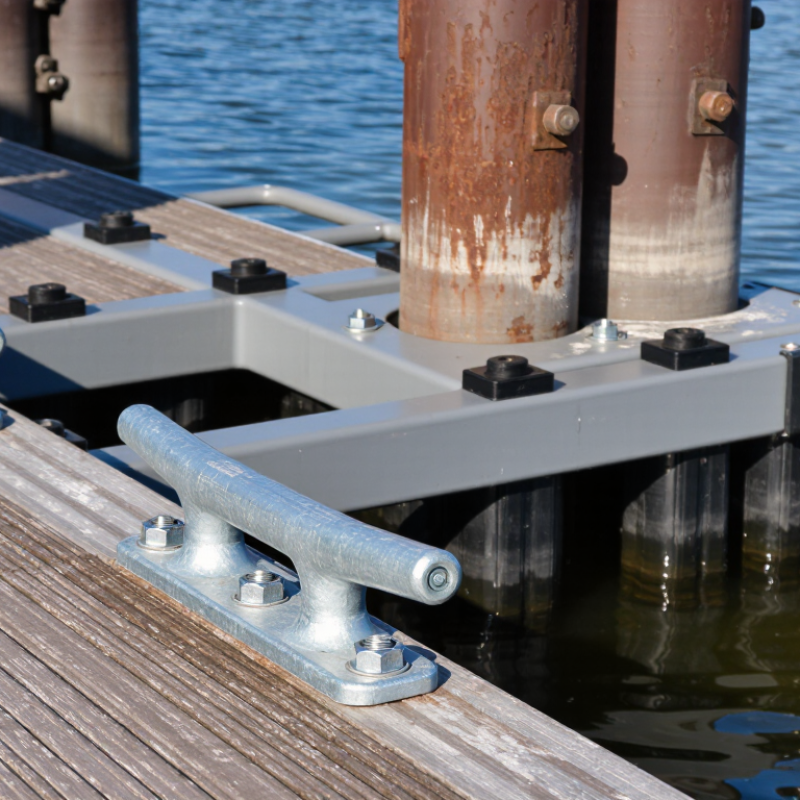
Floating dock hardware includes the parts that connect, stabilize, protect, and secure a dock system. Common items include frame connectors, hinge brackets, cleats, corner fittings, bumpers, anchors, chains, and stainless or galvanized fasteners. Some systems also use adjustable legs, gangway hinges, and flexible utility supports.
Each component faces different forces. Waves pull on anchors, while walking loads stress hinges and connectors. Saltwater accelerates corrosion, especially around damaged coatings and mixed metals. Marine-grade aluminum, stainless steel, and UV-resistant polymers can improve service life when selected correctly. However, material choice alone cannot solve poor design.
Experienced installers check bolt tightness, joint movement, and anchor alignment during routine inspections. After severe weather, they examine bent brackets, loose chains, cracked floats, and worn bumper sections. Small movement can become a serious failure. Compatibility matters too. Hardware must match the dock’s frame profile, expected load, water conditions, and tidal range.
A perfect specification rarely exists. I have seen durable hardware perform poorly when installation ignored local wave patterns. Maintenance access is often overlooked. It should not be. Buyers should request load data, corrosion guidance, installation instructions, and replacement details from qualified suppliers. Clear documentation makes global purchasing safer and reduces costly guesswork.
How to Evaluate Floating Dock Hardware Suppliers Worldwide Global buyers should evaluate floating dock hardware suppliers beyond price and catalog size. UNCTAD’s Review of Maritime Transport 2024 reported that seaborne trade grew 2.4% in 2023. That growth also exposes buyers to freight delays, port congestion, and changing delivery costs. Request documented lead times, export packaging details, replacement-part availability, and clear Incoterms.
Material evidence matters more than polished sales language. Check aluminum or galvanized steel specifications, fastener grades, corrosion testing, UV resistance, and allowable loads. Ask for engineering drawings and test reports linked to the exact product code.
PIANC marina guidance emphasizes safe access, stability, and durable marine construction. A supplier should explain how connectors perform during wave movement, repeated loading, and seasonal water-level changes.
Look closely at quality systems. ISO 9001 certification helps, but it does not replace product inspection. Request batch records, inspection photos, warranty conditions, and corrective-action procedures. The World Bank’s Container Port Performance Index 2023 assessed 405 ports, showing that logistics performance differs widely worldwide. Build this risk into purchasing plans. A low quotation may become expensive after delays or missing hardware. No scorecard is perfect. Small suppliers may offer strong technical support, while larger exporters may provide better continuity. Compare both, and record every assumption before signing.
When comparing floating dock hardware suppliers, global buyers should examine materials before reviewing prices. Marine-grade aluminum, often 6061-T6, offers low weight and useful corrosion resistance. Stainless steel 316 performs better around saltwater than 304. Hot-dip galvanized steel can suit heavy loads, but damaged coatings may rust quickly. Plastic components should include UV-stabilized HDPE or similar outdoor-grade polymers. Ask for material certificates, coating thickness records, and batch traceability.
Product standards deserve equal attention. Request documented load tests for brackets, hinges, cleats, rollers, and connection pins. Test reports should identify the sample, load direction, test duration, and failure point. Dimensional drawings must show hole spacing and tolerances. These details prevent expensive installation changes. A supplier claiming “marine quality” without evidence raises concern. I have seen attractive hardware fail because fasteners were overlooked. The main structure survived, but the small bolts did not.
Certifications can support reliability, but they are not automatic proof of performance. Check whether ISO 9001 covers the actual manufacturing site and product process. Review independent corrosion, fatigue, and load-test reports when available. For exported electrical accessories, verify applicable market certifications separately. Confirm that certificates remain valid and match the shipment model. A factory audit can examine welding, surface treatment, inspection tools, and packaging. No checklist is perfect. Even careful buyers may miss installation conditions, such as tidal movement, water chemistry, or repeated impact from service boats. Suppliers should explain these limits clearly, not hide them.
This chart shows the minimum average hot-dip galvanized coating thickness specified by ISO 1461 for fabricated iron and steel components, based on the steel section thickness. Buyers should request coating inspection records, material traceability, dimensional tolerances, and compliance documentation before approving floating dock hardware.
Key checks for global buyers: Confirm whether steel components comply with ISO 1461 or an equivalent national standard, verify stainless-steel grades such as 304 or 316 through material certificates, review fastener grades and corrosion protection, and request load, weld, salt-spray, and dimensional inspection records where applicable. ISO 1461 coating values are minimum average requirements and should not be treated as a substitute for application-specific marine design verification.
Floating dock hardware suppliers differ sharply in capability, pricing, and customization. A capable supplier should provide load calculations, corrosion-resistant fasteners, hinge specifications, and installation drawings. Ask whether testing covers wave movement, freezing temperatures, and repeated loading. A low quote may exclude anchors, transition plates, or replacement hardware. That omission can distort the real project cost.
Pricing usually depends on material grade, order volume, freight distance, and engineering support. Standard aluminum frames often cost less than fully engineered systems, but custom dimensions can improve stability and site access. Reliable suppliers explain every cost in a clear quotation. They should also provide sample parts, production timelines, inspection records, and responsive technical support. Documentation matters. Still, buyers should question impressive claims without measurable evidence.
Tips: Compare three itemized quotations, not only unit prices. Request a small sample before approving bulk production. Check bolt sizes, weld quality, float attachment points, and packaging strength. Confirm whether the supplier can adjust deck width, hinge spacing, cleat positions, and ramp angles. I would also test the planned layout with local water conditions. Generic specifications can mislead. One practical weakness is that buyers sometimes prioritize customization too early, before confirming basic load and maintenance requirements. That mistake can increase cost without improving daily use.
| Supplier Category | Typical Product Scope | Common Materials | Typical Load Rating | Indicative Hardware Price Range* | Customization Capability | Typical MOQ | Best Fit for Global Buyers |
|---|---|---|---|---|---|---|---|
| Local Marine Fabricator | Cleats, hinges, brackets, gangway fittings, anchor points, and replacement hardware | Marine-grade stainless steel, galvanized steel, aluminum, and engineering plastics | Approximately 0.5–5 metric tons per fitting, subject to engineering approval | US$15–US$250 per standard fitting; custom parts usually quoted separately | High for one-off fabrication; limited tooling and formal documentation | 1–20 pieces | Urgent repairs, prototype projects, and small marina upgrades |
| Regional Dock Hardware Manufacturer | Complete connection hardware for modular floating docks, fingers, ramps, and utility platforms | Hot-dip galvanized steel, powder-coated aluminum, stainless steel, and UV-stabilized polymers | Approximately 1–10 metric tons per connection assembly | US$30–US$600 per assembly, excluding freight and installation | Medium to high; can adapt dimensions, hole patterns, coatings, and connection layouts | 25–100 pieces | Commercial marinas, waterfront developments, and repeat regional orders |
| Contract OEM Manufacturer | Private-label dock brackets, hinges, rollers, cleats, pile guides, and structural connectors | 304 or 316 stainless steel, carbon steel, aluminum alloys, UHMW-PE, and glass-filled nylon | Approximately 1–20 metric tons per engineered component | US$8–US$350 per component at production volume | High; supports drawings, tooling, material changes, packaging, and inspection plans | 100–1,000 pieces, depending on process and tooling | Importers, distributors, and buyers requiring repeatable private-label supply |
| Heavy-Duty Industrial Fabricator | Pile guides, heavy hinges, expansion joints, crane-rated fittings, and wave-exposed structural hardware | Structural carbon steel, hot-dip galvanized steel, 316 stainless steel, and reinforced elastomers | Approximately 5–50 metric tons per assembly, based on engineered load cases | US$250–US$3,000 per heavy-duty assembly | High for engineered projects; normally requires drawings, calculations, and approval cycles | 5–25 assemblies | Tidal waterways, industrial ports, public infrastructure, and high-wind locations |
| Plastic and Composite Component Supplier | Rollers, wear pads, bumpers, spacers, guide blocks, and non-corrosive accessory components | UV-stabilized polyethylene, UHMW-PE, nylon, fiberglass-reinforced polymer, and EPDM | Approximately 0.2–5 metric tons per component, depending on geometry and mounting method | US$5–US$180 per component; tooling may add US$500–US$10,000 | High for molded or machined parts; color, hardness, profile, and dimensions can be adjusted | 50–500 pieces | Corrosion-sensitive sites, noise reduction, wear protection, and lightweight systems |
| Engineering and Project Supplier | Engineered dock packages including hardware schedules, structural interfaces, access ramps, and installation support | Combination of galvanized steel, stainless steel, aluminum, polyethylene floats, and composite decking interfaces | Project-specific; commonly designed around 2.5–10 kPa uniformly distributed pedestrian loads, with higher ratings requiring engineering review | US$150–US$1,500 per hardware position; complete systems are priced by project | Very high; includes site conditions, wave exposure, tidal range, accessibility, and local code requirements | Project-based; often 1 complete system or more | Large marinas, resorts, public waterfronts, and technically complex installations |
Global buyers need more than a low quotation when selecting floating dock hardware suppliers. UNCTAD’s Review of Maritime Transport 2024 reports that global seaborne trade reached about 12.3 billion tonnes in 2023. This scale increases demand for reliable dock connectors, hinges, rollers, brackets, and anchoring parts.
Verify the supplier through evidence, not promises. Request material certificates for stainless steel, aluminum, or galvanized components. Check tensile strength, coating thickness, salt-spray results, and working-load limits.
Ask for batch numbers and factory inspection records. ISO 9001 certification can support process control, but it does not prove product quality alone.
The World Bank’s 2023 Logistics Performance Index evaluates customs, infrastructure, tracking, and logistics competence. Use these areas when reviewing export performance. A supplier with clear packing photos, test reports, and shipment records is easier to assess.
Tips: Start with a small paid sample order. Measure hole spacing, weld quality, surface finish, and actual load behavior. Confirm drawings before production. Keep every specification in writing.
Some checks fail in practice. Certificates may describe a material grade, not the delivered batch. An independent inspection can expose this gap before a container leaves the factory.
Also compare response speed and technical questions; vague answers often signal weak engineering support. Price still matters, but replacement delays can cost more than the hardware.
Marine-grade aluminum is light and resists corrosion. Stainless steel 316 suits saltwater better than 304. Hot-dip galvanized steel handles heavy loads, but scratches can rust quickly.
Request material certificates, coating records, batch numbers, and traceability documents. Confirm they match the actual shipment. Paperwork can still contain gaps.
Ask for documented tests on brackets, hinges, cleats, rollers, and pins. Reports should show load direction, test duration, sample details, and failure points.
Drawings should show hole spacing, tolerances, thickness, and connection details. A two-millimeter mismatch can delay installation and force costly modifications.
No. A certification may cover factory procedures, not every delivered part. Check independent corrosion, fatigue, and load reports when available.
Review welding, surface treatment, inspection tools, packaging, and production records. Check whether the tested factory matches the shipping facility.
Start with a small paid sample order. Measure hole spacing, weld quality, surface finish, and actual load behavior. Samples may not represent every batch.
Consider tides, water chemistry, repeated impacts, and local weather. Service boats can strike connectors repeatedly. Even careful planning may miss real operating conditions.
Compare technical answers, packing photos, test reports, shipment records, and response speed. A low price may hide replacement delays and installation costs.
Floating Dock Hardware includes connectors, brackets, hinges, cleats, rollers, anchors, fasteners, and other components that help floating docks remain stable, secure, and adaptable to changing water conditions. Choosing reliable hardware matters because material quality, corrosion resistance, load capacity, and compatibility directly affect dock safety, service life, and maintenance costs. Global buyers should understand how each component functions and identify suppliers with consistent manufacturing processes and clear technical documentation.
When evaluating Floating Dock Hardware suppliers worldwide, buyers should compare materials such as marine-grade aluminum, stainless steel, galvanized steel, and durable polymers, while checking applicable product standards, testing records, and certifications. Supplier capability, production capacity, quality control, lead times, pricing, packaging, and customization options should also be reviewed. Before placing an order, buyers can verify samples, inspect specifications, request references, assess communication quality, and confirm after-sales support. A careful comparison helps select a dependable supplier that can deliver safe, compatible, and cost-effective solutions for different floating dock projects.

ShengHuang