Choosing the right Square Floating Pontoons starts with the project, not the product catalog. A private dock, marina walkway, floating platform, and temporary work station face different loads and exposure. Each needs a clear design brief. Measure people, equipment, wind, waves, current, and seasonal water-level changes before comparing prices.
NOAA’s 2022 Sea Level Rise Technical Report projects 10 to 12 inches of additional sea-level rise along U.S. coastlines by 2050, compared with 2000 levels. That finding makes freeboard, adjustable connections, and anchoring more important than they once seemed. PIANC guidance for floating structures also emphasizes buoyancy, stability, environmental loads, access, and maintenance. These are not decorative details. A low deck can become difficult to use when rainwater, cargo, or wake action reduces its freeboard.
A reliable selection process checks buoyancy calculations, load distribution, connector strength, float material, UV resistance, and corrosion protection. Review the manufacturer’s tested capacity, not only its marketing language. Ask whether the rating applies per module or to the assembled platform. That difference can be costly. ICOMIA’s Global Boating Statistical Abstract also shows the continuing scale of recreational boating activity, reminding project owners that heavy traffic and repeated impacts deserve serious planning. Still, a report cannot replace a site inspection. A calm lake may produce sharp wakes near a busy launch area. I have seen simple layouts fail because access, drainage, or maintenance was considered too late. This guide explains how to compare Square Floating Pontoons with practical judgment, credible specifications, and room for revision.
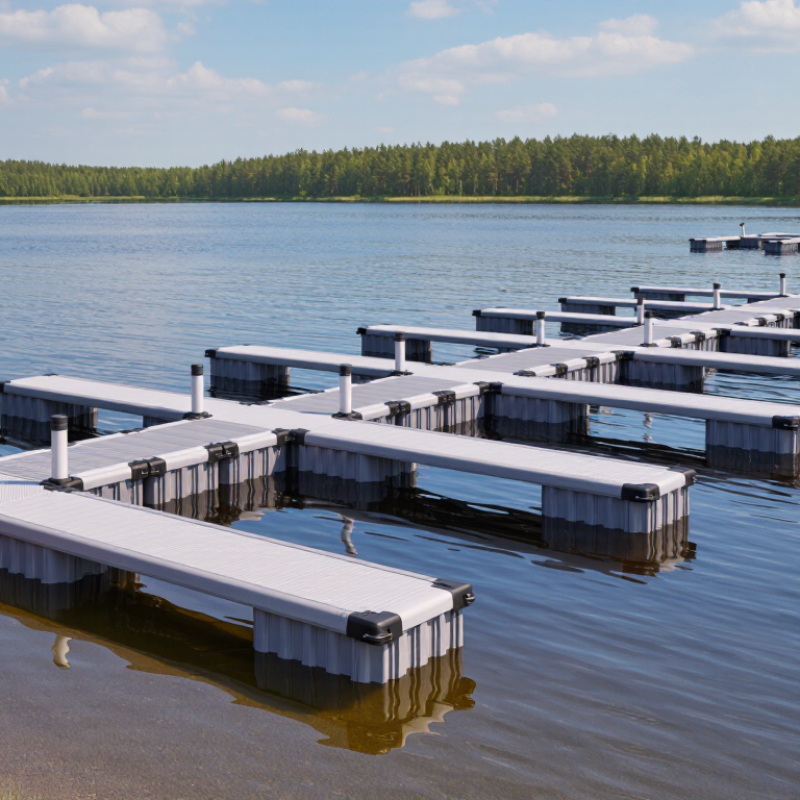
Define Project Requirements for Square Floating Pontoons
Choosing square floating pontoons starts with defining the project, not comparing shapes. Identify the intended use, water conditions, payload, access needs, and service life. A pedestrian platform needs different support than a work raft carrying generators or small vehicles.
Record dead loads, people, equipment, wave impact, current, and accidental loads. Then calculate buoyancy, trim, stability, freeboard, and connection forces. The U.S. Army Corps of Engineers Coastal Engineering Manual recommends assessing wave height, wave period, current, and water level separately. These inputs can change the required pontoon size and anchoring system.
Climate data also matters. NOAA’s 2022 Sea Level Rise Technical Report projects 10 to 12 inches of average rise along U.S. coastlines by 2050. The IPCC Sixth Assessment Report projects global sea-level rise of 0.28 to 1.01 metres by 2100, depending on emissions. A design that works today may lose freeboard later. A neat load table can still be wrong.
Tips: Measure the actual site during calm and rough conditions. Ask an engineer to verify buoyancy and stability. Check corner joints for twisting, especially on long square platforms. Leave practical access for inspection and repairs. Do not treat manufacturer capacity charts as complete engineering evidence. Local wave data, water-level records, and corrosion exposure deserve equal attention.
How to Choose Square Floating Pontoons for Any Project?
Define the project requirements first: water type directly affects the gross buoyancy available from each cubic metre of submerged pontoon volume.
The values are based on typical water densities: freshwater is approximately 1,000 kg/m³, brackish water approximately 1,015 kg/m³, and seawater approximately 1,025 kg/m³. Actual usable capacity must be reduced by the pontoon weight, deck structure, equipment, live loads, wave action, and the required safety reserve. Select square pontoons by comparing total project displacement with the available buoyancy at the intended operating water level.
Compare Pontoon Materials, Buoyancy, and Load Capacity
How to Choose Square Floating Pontoons for Any Project?
When choosing square floating pontoons, compare material before appearance or price. High-density polyethylene resists corrosion, impacts, and repeated contact with wet environments. It usually needs little maintenance, but strong sunlight can still cause aging over time. Aluminum is lighter and rigid, making transport and assembly easier. However, damaged coatings or dissimilar metals may create corrosion concerns. Steel provides strength for demanding platforms, yet it requires careful protection and regular inspection.
Buoyancy depends on displaced water, not the pontoon’s advertised size alone. One cubic meter of freshwater supports roughly 1,000 kilograms before accounting for the pontoon’s own weight. Saltwater provides slightly more lift. Leave meaningful freeboard above the waterline. Waves, people moving, stored equipment, and uneven loading can quickly reduce safety margins. Small details matter.
Calculate total weight carefully. Include frames, decking, fasteners, tools, fuel, and temporary loads. My early estimates were too optimistic because I ignored waterlogged decking and concentrated loads. That mistake changed the design. Distribute heavy items across several pontoons instead of placing them near one corner. Check the manufacturer’s load rating, connection strength, and performance under dynamic movement. A test fit with sandbags can reveal tilting, flexing, or insufficient freeboard before installation. Measure twice. Then inspect again.
How to Choose Square Floating Pontoons for Any Project? - Compare Pontoon Materials, Buoyancy, and Load Capacity
| Material |
Typical Material Density |
Typical 1 m × 1 m × 0.4 m Module |
Approx. Empty Module Mass |
Gross Buoyancy in Fresh Water |
Recommended Payload at 50% Submergence |
Strengths |
Best-Fit Applications |
| HDPE |
930–970 kg/m³ |
0.40 m³ external volume |
45–60 kg |
Approximately 400 kg |
Approximately 140–155 kg per module |
High impact resistance, buoyant, low maintenance, good resistance to water and many chemicals |
Floating walkways, work platforms, temporary docks, recreational pontoons, modular systems |
| Marine-Grade Aluminum |
2,660–2,800 kg/m³ |
0.40 m³ external volume |
35–50 kg |
Approximately 400 kg |
Approximately 150–165 kg per module |
High strength-to-weight ratio, rigid construction, easy to fabricate, suitable for framed platforms |
Boat access systems, service platforms, lightweight docks, transportable floating structures |
| Fiberglass-Reinforced Plastic (FRP) |
1,500–2,000 kg/m³ |
0.40 m³ external volume |
50–75 kg |
Approximately 400 kg |
Approximately 125–150 kg per module |
Good corrosion resistance, electrically non-conductive, smooth surface, suitable for wet and marine environments |
Permanent docks, access ramps, utility platforms, corrosive or electrically sensitive environments |
| Galvanized or Coated Steel |
Approximately 7,850 kg/m³ |
0.40 m³ external volume |
90–130 kg |
Approximately 400 kg |
Approximately 70–110 kg per module |
High rigidity, high impact resistance, suitable for heavy structural frames and industrial platforms |
Heavy-duty work platforms, industrial access systems, construction support platforms |
Planning basis: Gross buoyancy is calculated from approximately 1,000 kg of freshwater displacement per cubic metre. The recommended payload estimate assumes the module is limited to about 50% submergence and subtracts the module's own mass; it is a preliminary planning value, not a certified working load. Actual capacity must also account for freeboard, wave action, uneven loading, connections, decking, anchoring, current, wind, water density, and local design requirements.
Select the Right Dimensions, Layout, and Connection System
How to Choose Square Floating Pontoons for Any Project?
Choosing square floating pontoons starts with real loads, water conditions, and daily movement patterns. A 2 × 2 metre module suits compact platforms and simple access routes. Larger modules reduce joints but become harder to transport and repair. Keep enough reserve buoyancy for users, equipment, rainwater, and uneven loading. BS 6349-8 and PIANC Report No. 149 commonly support checking a preliminary pedestrian load near 2.5 kN/m². Confirm the final value with a qualified engineer and local conditions.
Layout affects safety more than appearance. Align modules with prevailing waves when possible, then place wider sections where people gather. Offset joints can prevent one continuous weak line across the platform. Add service gaps for cables, pumps, or emergency access. Connection systems should match movement, not resist it blindly. Hinged links suit moderate water-level changes, while flexible couplers can reduce impact between modules. Rigid connections may feel stable, but they can transfer wave forces into corners. Inspect bolt holes, pins, and wear plates regularly. Small errors matter.
PIANC guidance recommends considering wind, waves, currents, berthing, and operational loads together. Site measurements should support the design, not replace them. I would also test the layout with one-sided crowd loading and a failed-module scenario. Do not guess. A neat square grid can still create dangerous access points if connectors rotate unexpectedly. The honest design question is not only whether the pontoon floats, but whether it remains usable after weather, wear, and imperfect loading.
Evaluate Stability, Safety Features, and Environmental Conditions
How to Choose Square Floating Pontoons for Any Project?
Evaluate Stability, Safety Features, and Environmental Conditions
Square floating pontoons should be selected by measured loads, not appearance. Start with total weight, including people, equipment, fuel, rainwater, and possible snow. Buoyancy alone is not stability. A wide platform, evenly spaced floats, and a low center of gravity reduce tilting during movement. Check freeboard under full load. Small margins matter.
The U.S. Coast Guard recorded 3,844 recreational boating accidents and 564 deaths in 2023. This data shows why access safety deserves equal attention. Use slip-resistant decking, secure handrails, edge protection, and visible lighting. Connection points should resist repeated pulling from waves and wakes. Inspect bolts, hinges, welds, and float chambers after severe weather. A checklist can still miss hidden fatigue.
Environmental conditions change the design. NOAA reported 28 U.S. billion-dollar weather and climate disasters in 2023, showing how quickly exposure can intensify. Review local wind records, wave height, currents, tides, ice, ultraviolet exposure, and corrosion risks. Anchoring systems need flexibility for changing water levels, while mooring lines require protection against abrasion. In brackish or marine water, inspect metal fittings more frequently. Materials rated for freshwater may disappoint there. That is easy to overlook. Finally, test the assembled pontoon at partial and full load before regular use. Real behavior can challenge calculations.
Plan Installation, Maintenance, and Future Expansion
Choosing square floating pontoons starts with the future, not the shoreline. Measure boat traffic, water depth, wave exposure, and expected users. Square modules simplify layout changes and create predictable walking paths. However, they need stable connections and carefully placed anchors. A neat drawing can behave differently on moving water.
NOAA’s 2022 Sea Level Rise Technical Report projects 10 to 12 inches of additional U.S. coastal rise by 2050. That projection affects freeboard, ramp angles, anchor loads, and access planning. The U.S. Army Corps of Engineers Coastal Engineering Manual also stresses site-specific wave, wind, and current analysis. Do not choose buoyancy from surface area alone. Calculate people, equipment, snow, and uneven loads. Leave reserve capacity. I have seen projects fail because storage weight was treated as an afterthought.
Tips: Keep spare connection points for future expansion. Use corrosion-resistant hardware suited to local water chemistry. Inspect hinges, bolts, floats, and anchor lines after severe weather. Record movement and repairs with dated photographs. The inspection log may feel excessive. It rarely is. Plan removable sections near service areas, but avoid creating trip edges. Consult a qualified marine engineer when currents, tides, or public access increase risk. Use the latest local code requirements, because older drawings may quietly mislead.
FAQS
Define the platform’s use, payload, water conditions, access needs, and expected service life. A pedestrian walkway needs different support than a work raft carrying equipment. Do not compare shapes too early.
Include the platform weight, people, equipment, rainwater, waves, currents, and accidental loads. Check uneven loading, such as a crowd standing along one edge. Small omissions can affect stability.
Calculate buoyancy, trim, stability, connection forces, and freeboard together. Leave reserve buoyancy for users, equipment, water, and uneven weight. A floating platform should not sit too low.
Measure wave height, wave period, currents, and changing water levels separately. Calm water can hide problems found during wind or rough conditions. Site data matters.
A two-by-two-metre module can suit compact platforms and simple access routes. Larger modules reduce joints but may be harder to transport, inspect, and repair. Bigger is not always better.
Align modules with prevailing waves when practical. Use wider sections where people gather, and offset joints to avoid one weak line. Leave service gaps for cables, pumps, and emergency access.
Match the connection system to expected movement and water-level changes. Hinged links can suit moderate changes, while flexible couplers may reduce impacts. Rigid connections can transfer wave forces into corners.
Inspect bolt holes, pins, wear plates, corner joints, and areas exposed to corrosion. Check for twisting, especially on long square platforms. I would not trust a capacity chart alone. The estimate may be wrong.
Conclusion
Choosing the right Square Floating Pontoons begins with a clear understanding of the project’s purpose, location, expected users, and operating conditions. Consider whether the platform will support walkways, work areas, leisure activities, equipment, or future additions. Compare available materials by examining durability, corrosion resistance, buoyancy, weight, and load capacity. The pontoon’s dimensions, arrangement, and connection system should match the site layout while allowing secure assembly and practical access.
Stability and safety are equally important. Review freeboard, weight distribution, anchoring, surface grip, edge protection, and resistance to wind, waves, currents, temperature changes, and water exposure. Installation should include a realistic plan for transportation, positioning, connections, and inspections. Regular maintenance can extend service life by identifying damage, loose fittings, or material wear early. Finally, select a modular design that can be adjusted or expanded as project needs develop, ensuring the floating platform remains reliable, safe, and cost-effective over time.

 ShengHuang